8 Incredible Social Media Risk Management Apps for Business
Social media has grown way past marketing. These days it touches brand reputation, customer support, cybersecurity, legal compliance, HR, executive visibility, employee conduct, all of it. That bigger footprint creates a much wider risk surface, and in our experience, managing it well takes more than a single piece of software.
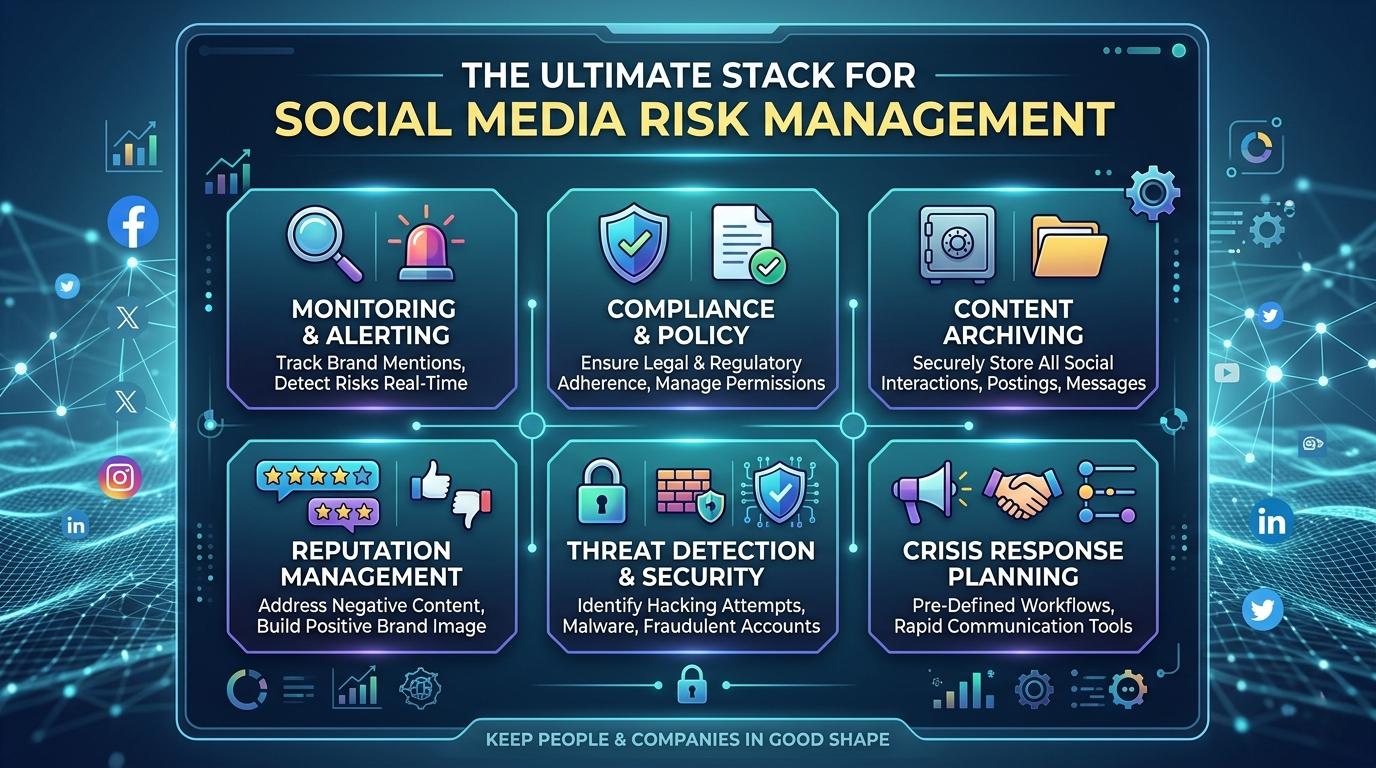
We’ve yet to find a single vendor that covers every part of social media risk. Brand protection, content governance, threat monitoring, compliance, cleanup, they each ask for different capabilities. So the smart move, and the one we’d make, is to build a stack that fits your size, industry, regulatory exposure, and risk tolerance.
Let’s walk through some of our in-house favorites for managing not only our social media risk, but social media in general. The pieces of software listed in this post are some of the highest quality apps in the world, let’s take a look at each one.
Cleaning Up Historical Digital Footprints
Before you worry about future posts, we’d look hard at what’s already out in the wild. Years of old posts, comments, likes, shares, and forgotten account activity can create reputational, privacy, or security headaches long after they went up, and trust us, it’s not a rare occurrence.
We treat historical cleanup as the first layer because it shrinks your exposure before anything blows up. And that goes for your company accounts and your public-facing employees alike.
Redact
Full disclosure, this one’s ours. We built Redact to clear out old and risky content across 35+ platforms, for your team and the company itself, cleaning up posts, comments, likes, DMs, and more. And we never store your data or your logins.
Never stores your data or logins.
We harp on this layer because legacy content gets ignored right up until it becomes visible for the wrong reason. And once it goes viral, the genie isn’t going back in the bottle.
Publishing Governance: Stopping Bad Posts Before They Go Live
Some of the fastest-moving risks we see come from inside the organization, not outside. A rogue post, an unapproved campaign, a poorly worded reply, or a compromised account can turn into a public mess in minutes.
This is where publishing governance tools earn their keep, giving you permissions, approval workflows, content calendars, account controls, and emergency response options.
Sprout Social
We rate Sprout as a strong pick for centralized management. The value for us is in the team permissions, approval workflows, and unified inbox that let you control who can publish, respond, and manage conversations across channels.
Hootsuite
If you’re juggling a pile of accounts across platforms, this is the one we’d point you to. Its enterprise features help you coordinate publishing, lock down access, and pause scheduled content during sensitive moments or live incidents.
For us, this part of the stack is all about catching mistakes before they ever hit the public feed.
Monitoring Public Sentiment as an Early Warning System
We’d argue listening matters just as much as publishing. The early signs of a PR issue, customer backlash, a viral complaint, or brand drama usually show up in public conversations before they snowball into a real story.
Social listening and sentiment monitoring tools are how we catch those signals early.
Brandwatch
We reach for Brandwatch when we want deep consumer intelligence and large-scale conversation analysis. It helps you spot emerging trends, track sentiment, flag potential backlash, and understand how the conversation is shifting around a brand, campaign, product, or issue.
Meltwater
Meltwater is our go-to when we want social listening and broader media monitoring together. If your comms team needs to track social chatter next to press coverage, seeing both in one workflow gives you a far clearer picture of how a story is spreading.
This is the layer that moves you from reactive crisis response to catching things early and deciding faster, which is exactly where we want to be.
Protecting Brand Assets from External Cyber Threats
Not every risk starts with one of your own posts. Impersonation accounts, fake profiles, phishing campaigns, fraudulent brand pages, account takeover attempts, and executive spoofing are external threats, and they call for more specialized security tools.
Honestly, these sit a lot closer to cybersecurity than to traditional social media management.
ZeroFox
ZeroFox is built for external digital risk protection, sniffing out impersonation accounts, fraudulent profiles, phishing, brand abuse, executive threats, and other social engineering. If you’ve got a high-value brand, public executives, a big customer base, or sensitive operations, we’d treat this layer as critical, not optional.
Tools like this close the gap between marketing, security, and risk management, and in our experience that gap is wider than most teams realize.
Archiving & Recordkeeping for Regulated Industries
If you’re in a regulated industry, social media isn’t just public communication, it’s a business record. Financial services, healthcare, government, education, and other regulated sectors often have to preserve social activity for compliance, legal review, public records requests, or litigation.
That’s what archiving tools do for you: they capture social content in a searchable, defensible format.
Smarsh
We see Smarsh all over financial services and other heavily regulated shops. It captures and retains your social communications in a way that lines up with recordkeeping requirements.
Pagefreezer
Pagefreezer is the one we’d lean on for legal-grade archiving and litigation readiness. It captures content, edits, deletions, metadata, and historical versions so you can prove exactly what happened, and when.
This layer isn’t about day-to-day publishing for us, it’s about having documentation you can stand behind.
Building the Right Stack for Your Organization
We’ll be straight with you: there’s no universal social media risk stack. A regional credit union has different needs than a public consumer brand. A public agency plays by different rules than a SaaS company. A founder-led startup carries a totally different risk profile than a regulated enterprise.
What we’d do is map your actual exposure across these five areas:
What’s already out there?
Which old posts, comments, likes, or account activity could create risk today?
Who controls the feed?
Who can post, approve, reply, schedule, or pause content across your accounts?
How fast do you see it?
How quickly can you detect a reputation issue or a shift in sentiment?
Who’s watching the perimeter?
Who’s tracking impersonation, phishing, fake accounts, and brand abuse?
What must you preserve?
What needs to be retained for legal, regulatory, or public records purposes?
You don’t need every category fully built out on day one, almost nobody does. But you do need a clear view of where you’re exposed and which gaps are most likely to hurt you first.
The strongest programs we’ve seen aren’t built around a single tool. They’re built around a deliberate system that combines cleanup, governance, monitoring, protection, and recordkeeping into one practical strategy.
Start with the foundation
Every layer gets easier once the historical exposure is gone, and that’s our wheelhouse. Redact clears old posts, comments, likes, and DMs across 35+ platforms for you and your team, and we never store your data.
Clean up your footprint free →